

Introduction
Nepal has a long-standing economic challenge: it imports significantly more goods than it exports. From petroleum products and vehicles to machinery, electronics, medicines and industrial raw materials, the country depends heavily on foreign markets to meet domestic demand. Although Nepal exports products such as carpets, tea, cardamom, textiles and processed goods, the value of imports remains considerably higher.
This difference between the value of merchandise imports and exports is known as the trade deficit. It affects Nepal's industrial development, employment, foreign trade and long-term economic competitiveness. Understanding why the deficit exists and how the country can address it is important for building a stronger economy.
1. What Is Nepal's Trade Deficit?
A trade deficit occurs when a country spends more on imported goods than it earns from exporting goods. Nepal has experienced this imbalance for many years because its domestic production and export capacity have not grown enough to match demand for imported products.
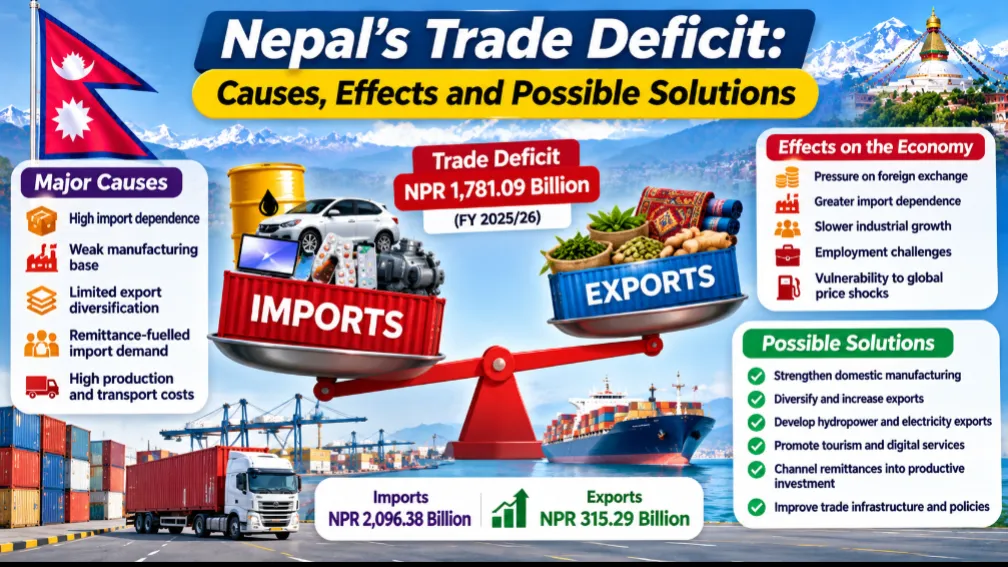
According to Nepal Rastra Bank's annual macroeconomic report, Nepal's merchandise trade deficit reached approximately NPR 1,781.09 billion (NPR 17.81 kharba) in FY 2025/26, increasing by 16.6% compared with the previous year.
Nepal's Foreign Trade: FY 2025/26
| Trade Indicator | Value |
|---|---|
| Total merchandise imports | NPR 2,096.38 billion |
| Total merchandise exports | NPR 315.29 billion |
| Merchandise trade deficit | NPR 1,781.09 billion |
| Annual deficit growth | 16.6% |
| Export-import ratio | 15.0% |
The export-import ratio of 15% means Nepal earned approximately NPR 15 from merchandise exports for every NPR 100 spent on merchandise imports. In other words, exports covered only a small portion of the country's import bill.
Important: These figures cover merchandise trade. They do not include the full value of services such as tourism, transport and digital services, or remittance receipts. A merchandise trade deficit is therefore not the same as a balance-of-payments deficit.
2. Major Causes of Nepal's Trade Deficit
A. Heavy Dependence on Imported Products
Nepal imports many products that are essential for households, businesses and infrastructure development. Petroleum products, vehicles, machinery, electronics, industrial materials, medicines and agricultural inputs account for significant import spending.
The country does not yet have sufficient domestic production capacity to replace many of these imports. As a result, demand for imported products continues even when domestic industries have the potential to produce some alternatives.
B. Weak Manufacturing and Industrial Production
Limited industrial development is one of the structural reasons behind Nepal's trade imbalance. Many industries face challenges involving electricity reliability, transportation costs, access to finance, technology, skilled workers and policy uncertainty.
When local production is expensive or insufficient, businesses often find it easier to import finished goods rather than manufacture them domestically. This increases import dependence and limits opportunities to develop competitive export industries.
C. Low Export Diversification
Nepal's exports are concentrated in a relatively limited range of products and markets. Products such as cardamom, tea, carpets, textiles, jute goods and processed vegetable oils contribute to export earnings, but the country has not developed a sufficiently broad export base.
Dependence on a small number of products makes export earnings vulnerable to changes in international prices, demand, trade policies and competition from other countries.
D. Remittance-Fuelled Import Demand
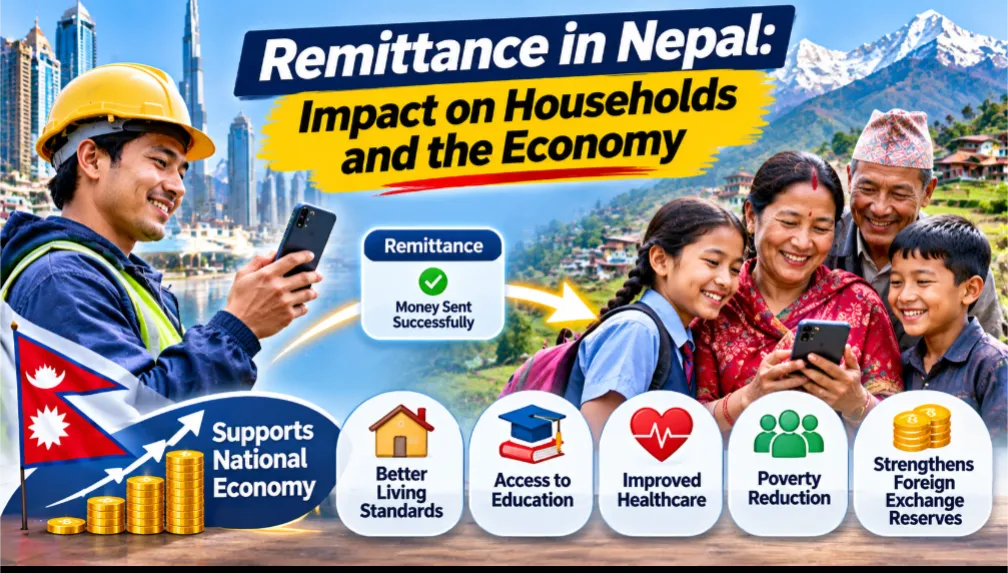
Remittances sent by Nepalis working abroad are an important source of foreign currency and household income. They support consumption, education, housing and investment. However, when household spending is directed mainly towards imported products, higher remittance income can also contribute to import growth.
Remittances do not automatically cause a trade deficit. They also strengthen foreign-exchange availability and help finance imports. The bigger challenge is that a relatively small share of this income is converted into productive investment that expands domestic production and exports.
E. High Production and Transportation Costs
Nepal's landlocked geography creates additional transportation and logistics challenges. Businesses depend on transit routes through neighbouring countries to access international markets. Delays, freight costs, customs procedures and limited logistics infrastructure can make Nepali exports less competitive.
Domestic production can also become expensive because of imported raw materials, financing costs, limited economies of scale and inconsistent supply chains.
F. Limited Technology, Skills and Investment
Many Nepali industries need modern machinery, research, technical skills and investment to improve productivity. Without these improvements, businesses may struggle to meet international quality standards, produce at competitive prices or expand into new markets.
3. Effects of the Trade Deficit on Nepal's Economy
A. Pressure on Foreign Exchange
Imports require foreign currency, while merchandise exports generate foreign-exchange earnings. A persistent trade imbalance can increase the need for foreign currency from remittances, tourism, foreign investment and other external receipts.
However, a large trade deficit does not automatically mean Nepal faces an immediate foreign-exchange crisis. Nepal's external position also depends on remittances, service exports, capital flows and foreign-exchange reserves.
B. Dependence on Foreign Markets
Heavy dependence on imported fuel, machinery, medicines and essential products can expose Nepal to international price increases and supply disruptions. Global conflicts, transport interruptions or changes in export restrictions by supplier countries can affect domestic prices and availability.
C. Limited Growth of Domestic Industries
When imported products dominate markets, domestic manufacturers may find it difficult to compete, particularly when they face higher production costs. This can discourage investment in local manufacturing and reduce opportunities to develop new industries.
D. Employment and Income Challenges
Weak manufacturing and export industries limit opportunities for skilled and semi-skilled workers. If domestic businesses cannot expand, more young people may look for employment abroad, increasing the economy's dependence on overseas earnings.
E. Exposure to External Economic Shocks
Nepal's dependence on imported petroleum, industrial materials and consumer goods makes the economy sensitive to international price fluctuations. A sudden increase in fuel prices, for example, can raise transportation and production costs across several sectors.
4. Possible Solutions to Reduce Nepal's Trade Deficit
A. Strengthen Domestic Manufacturing
Nepal needs to increase the production of goods that can be manufactured competitively within the country. Agriculture processing, construction materials, textiles, medicines, food products and selected industrial components offer opportunities for domestic production.
The government can support competitive industries through predictable policies, better infrastructure, easier access to finance, technical training and efficient public services. Protection alone is not enough; local businesses must also improve quality and productivity.
B. Diversify Exports and Explore New Markets
Nepal should develop products and services that can compete internationally. Potential areas include high-value agricultural products, tea, coffee, cardamom, medicinal herbs, carpets, handicrafts, processed foods and information technology services.
Exporters also need support with international certification, packaging, branding, market research and trade promotion. Expanding beyond a small number of traditional markets can reduce dependence on individual trading partners.
C. Increase Hydropower and Electricity Exports
Nepal has substantial hydropower potential. Developing reliable electricity generation, transmission lines and cross-border power trade can create export earnings and reduce dependence on imported fossil fuels in suitable sectors.
Electricity can also support domestic industries by providing a more reliable energy source for manufacturing, transport and commercial activities. However, hydropower projects need responsible planning, financing, environmental safeguards and access to electricity markets.
D. Develop Tourism and Digital Services
Tourism brings foreign currency into Nepal through spending on accommodation, transport, food, trekking and other services. Improving airports, roads, tourism infrastructure, safety and destination promotion can increase the sector's contribution.
Similarly, software development, IT consulting, digital design, business-process services and other exportable digital services can generate foreign earnings without depending entirely on physical goods exports.
E. Improve Trade Infrastructure and Customs Efficiency
Efficient roads, dry ports, warehouses, border facilities and digital customs systems can reduce transportation costs and delivery delays. Better trade logistics can make Nepali products more competitive in international markets.
F. Channel Remittances into Productive Investment
Remittances should be connected more effectively with entrepreneurship, manufacturing, agriculture, tourism and technology businesses. Financial education, suitable investment products and transparent business opportunities can encourage households to invest part of their savings in productive activities.
This does not mean discouraging household consumption. It means creating attractive opportunities for a portion of remittance income to support employment and domestic production.
G. Improve Policy Stability and Attract Investment
Businesses need predictable tax policies, transparent regulation, reliable electricity, access to land and efficient public services. Frequent policy changes and administrative delays can discourage both domestic and foreign investors.
Improving the investment environment can help Nepal attract technology, capital and expertise that support export-oriented industries.
5. Is Eliminating the Trade Deficit Realistic?
Completely eliminating Nepal's trade deficit in the short term is unlikely to be realistic. The country needs imported machinery, fuel, technology, medicines and industrial raw materials to support development. Some imports can help expand future production and exports.
The objective should therefore be to make imports more productive, strengthen domestic industries and increase competitive exports. A country does not necessarily become economically stronger simply by importing less. It becomes stronger when its businesses produce more value, create jobs and earn sustainable income from domestic and international markets.
Conclusion
Nepal's trade deficit is a major structural economic challenge linked to import dependence, limited manufacturing capacity, low export diversification and high production and logistics costs. The latest annual figures show that merchandise imports continue to exceed exports by a substantial margin.
Reducing this imbalance requires more than import restrictions. Nepal needs stronger industries, competitive agricultural and manufactured exports, better infrastructure, reliable electricity, tourism development and growth in digital services. Productive investment of remittance income and consistent economic policies will also be important.
The long-term goal should not simply be to reduce imports. It should be to build an economy capable of producing more, exporting more, creating better employment opportunities and earning foreign currency through competitive goods and services.
References and Further Reading
- Nepal Rastra Bank – Current Macroeconomic and Financial Situation, FY 2025/26.
- World Bank – Nepal Development Update.
- International Monetary Fund – 2026 Article IV Consultation with Nepal.
- Department of Customs, Nepal – Foreign trade statistics and customs information.
- U.S. International Trade Administration – Nepal Market Overview.
Disclaimer: This article is for educational and informational purposes. Trade statistics are based on the cited reporting period and may be revised by the relevant authorities. Policy recommendations are analytical suggestions, not official government commitments.





Comments
Sign in to leave a comment.
Sign in