
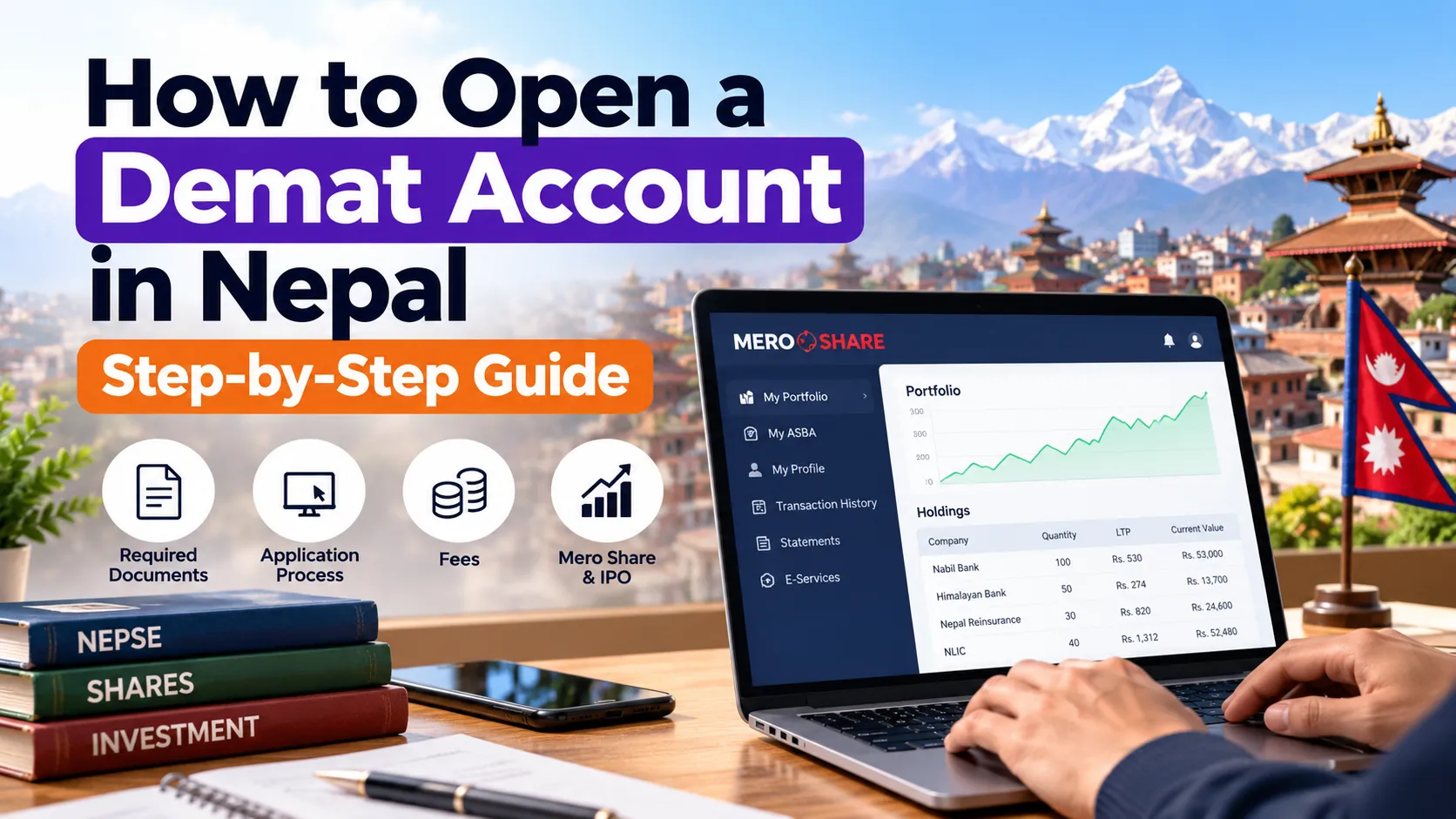
A Demat account is one of the first things you need if you want to invest in Nepal's stock market. Whether you plan to apply for an Initial Public Offering (IPO), receive bonus shares, or hold shares of companies listed on the Nepal Stock Exchange (NEPSE), a Demat account helps you keep your investments in electronic form.
The good news is that opening a Demat account in Nepal is relatively straightforward. You can apply through a bank, a capital company, or another authorized Depository Participant (DP). Depending on the institution, you may be able to complete the application online or visit a branch.
In this guide, we explain how to open a Demat account in Nepal, the documents required, the application process, the associated fees, and what to do after your account is approved.
## What Is a Demat Account?
A Demat account, short for dematerialized account, is an account used to hold shares and other eligible securities electronically instead of in physical paper certificates.
In Nepal, these accounts operate through the central depository system managed by CDS and Clearing Limited (CDSC). Investors open their accounts through authorized Depository Participants rather than directly with CDSC.
A Demat account can be used to hold securities such as:
- Shares purchased through the stock market.
- Shares allotted through IPOs.
- Bonus shares and rights shares.
- Other eligible securities, including certain debentures and mutual fund units.
If you are new to investing, opening a Demat account is an important first step toward participating in Nepal's securities market.
## Documents Required to Open a Demat Account in Nepal
Before applying, prepare the documents and information requested by your chosen Depository Participant.
Common requirements include:
- A valid Nepali citizenship certificate.
- Recent passport-size photograph.
- Bank account details.
- Personal information, address, contact number, and email address.
- Signature and completed application form.
- National Identity Card details or other KYC information, where required by the current rules and the provider.
Some institutions may request additional documents depending on your circumstances. For example, applications for minors generally require a birth certificate and guardian documentation. Requirements may also differ for Nepali citizens living abroad and institutional applicants.
Check the current checklist with your chosen DP before submitting your application.
## Step-by-Step Process to Open a Demat Account in Nepal
Follow these steps to open your account and prepare for investing in the Nepali stock market.
### Step 1: Choose a Depository Participant (DP)
First, choose an authorized Depository Participant. Banks, capital companies, and eligible securities firms provide Demat account services.
You can compare providers based on their service fees, online application process, customer support, and access to Mero Share.
You can find the official list of Depository Participants through the CDSC website: https://cdsc.com.np/
### Step 2: Prepare Your Documents
Collect your citizenship certificate, photograph, bank details, and other required KYC information.
Check the latest requirements with your chosen DP before applying, particularly if you have not yet obtained your National ID number. Identification requirements may change, so verify the current rules before submitting your application.
Make sure your name, date of birth, and other personal details match your official documents to reduce the risk of application delays.
### Step 3: Apply Online or Visit a Branch
Many providers offer online Demat account applications, while others may require you to visit a branch for verification.
For an online application, visit the provider's official website and complete the application form. Enter your personal information, address, bank details, and identification information as requested.
Upload clear copies of the required documents and complete any identity verification process.
If you prefer an offline application, visit your selected DP with your original documents and copies. Complete the form and follow the staff's instructions for verification.
### Step 4: Pay the Applicable Fees
The provider will explain any account-opening charge and applicable annual maintenance fees.
Before paying, confirm the current Demat fee, renewal fee, and any additional service charges directly with the DP. Charges can vary by provider and may change over time.
Keep your payment receipt or transaction confirmation for future reference.
### Step 5: Receive Your Demat Account Number (BOID)
After your application has been verified and approved, you will receive a BOID (Beneficial Owner Identification Number) associated with your Demat account.
In Nepal, a BOID is a 16-digit identification number used to identify your Demat account within the depository system.
Keep this number safe. You will need it when registering for Mero Share, applying for IPOs, and managing your securities.
The approval time depends on the provider and whether your documents require additional verification. Ask your DP for an estimated processing time.
### Step 6: Register for Mero Share
Opening a Demat account does not automatically mean you have access to every online investment service.
Mero Share is an online service operated by CDSC that allows investors to view their holdings and use supported securities-related services.
To register:
1. Contact your DP or follow its instructions for requesting Mero Share.
2. Visit the official Mero Share portal: https://meroshare.cdsc.com.np/
3. Select your Depository Participant and enter the required account information.
4. Use the credentials provided by your DP to log in.
5. Follow the instructions to change your password and secure your account.
Mero Share can be used to view your portfolio and submit eligible IPO, FPO, and rights-share applications through the supported electronic application process.
### Step 7: Obtain Your C-ASBA Registration Number (CRN)
If you want to apply for IPOs, you will generally need a CRN (C-ASBA Registration Number) from a participating bank.
Contact your bank to confirm its registration procedure and the documents required. Your bank account and Demat details must be correctly linked for the application process.
Once the required services are active, you can use Mero Share's My ASBA section to apply for eligible public issues when applications are open.
Remember that having a Demat account alone does not automatically make you ready to apply for an IPO. You should also complete the necessary Mero Share and C-ASBA arrangements.
## How Much Does It Cost to Open a Demat Account in Nepal?
The total cost depends on the provider and the services you choose.
- Demat account opening: Check whether the provider charges a one-time fee.
- Annual Demat maintenance: Confirm the current annual renewal charge.
- Mero Share: Check the applicable subscription fee.
- C-ASBA: Ask your bank about any applicable charges.
- Broker trading account: Separate account and service requirements may apply.
Do not rely on an old fee table without checking its date. CDSC publishes official notices and fee-related information on its website: https://cdsc.com.np/
## Demat Account vs Mero Share vs Trading Account
These three services have different purposes, and beginners often confuse them.
### Demat Account
A Demat account holds shares and other eligible securities electronically.
### Mero Share
Mero Share lets you view holdings and use supported online securities services, including eligible public issue applications.
### Broker Trading Account
A broker trading account lets you buy and sell shares in the secondary market through a licensed broker.
If your immediate goal is to apply for IPOs, start by arranging your Demat account, Mero Share access, and CRN. If you also want to buy and sell shares on NEPSE's secondary market, you will need to complete the broker's trading-account registration process.
## Frequently Asked Questions (FAQs)
### Can I open a Demat account online in Nepal?
Yes. Several banks and capital companies offer online applications. However, the verification process and whether a branch visit is necessary depend on the provider.
### How long does it take to open a Demat account?
Processing times depend on the provider, document verification, and application volume. Contact your selected DP for an estimated timeline.
### Can students open a Demat account in Nepal?
Students who meet the applicable eligibility requirements can generally apply. Minors require a guardian and additional documentation. Confirm the process with your chosen DP.
### Can Nepali citizens living abroad open a Demat account?
Some providers support online applications or specific verification procedures for Nepali citizens living abroad. Requirements differ, so contact the DP before starting your application.
### Is a Demat account enough to buy shares on NEPSE?
No. A Demat account holds your securities, but buying and selling shares on the secondary market generally requires a separate trading account with a licensed broker.
### Is opening a Demat account the same as investing?
No. Opening an account is an administrative step, not an investment. You still need to understand the securities you purchase, the risks involved, and your financial goals.
## Conclusion
Opening a Demat account in Nepal is an important first step for anyone planning to participate in the country's securities market. Choose an authorized Depository Participant, prepare the required documents, complete verification, and keep your BOID safe.
If you want to apply for IPOs, arrange Mero Share access and obtain your CRN from a participating bank. If you want to trade shares on the secondary market, you will also need a broker trading account.
Before submitting your application, verify the latest documentation requirements and fees with your chosen provider. Most importantly, remember that a Demat account provides access to securities services; it does not guarantee investment profits.





Comments
Sign in to leave a comment.
Sign in