
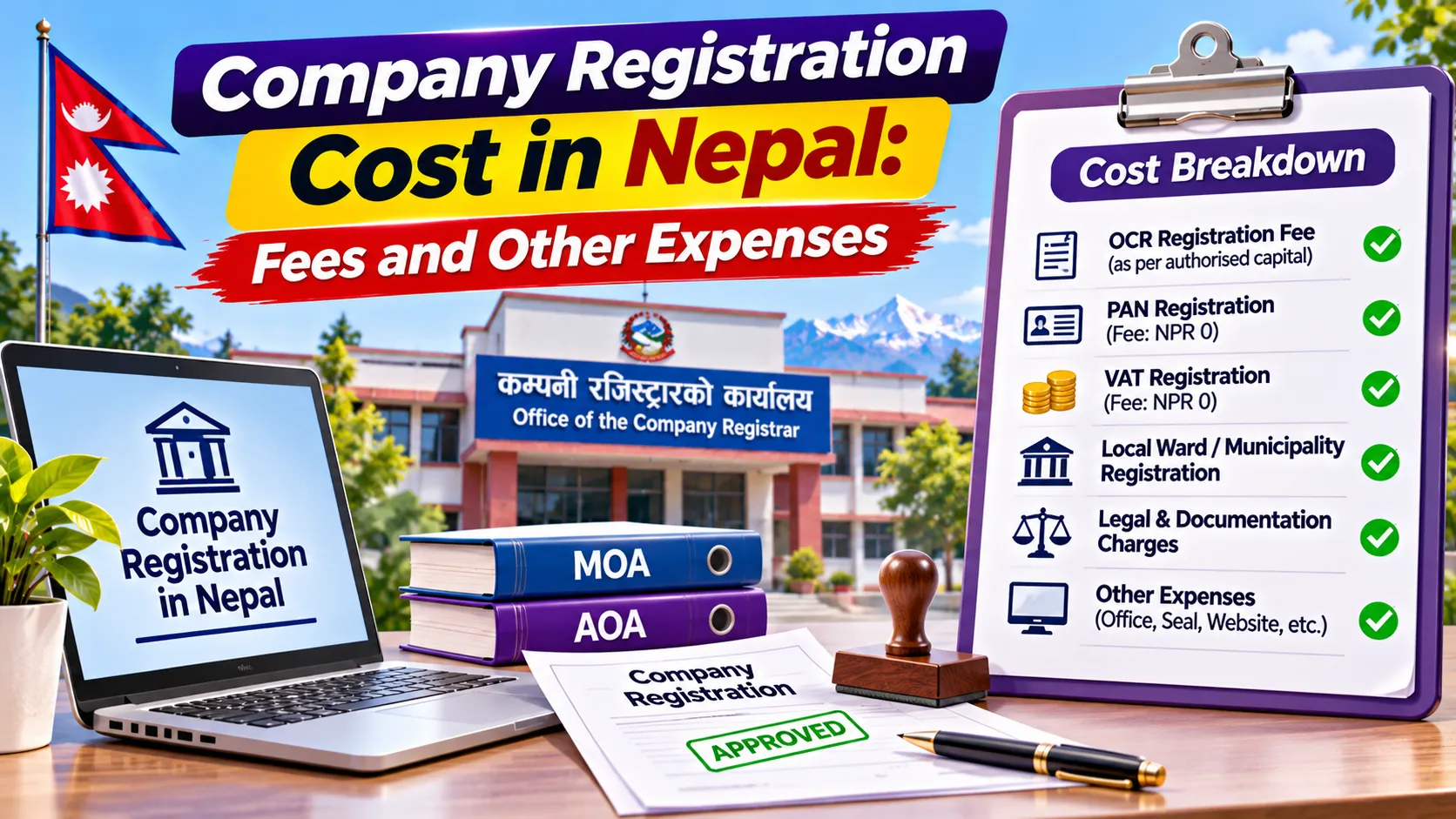
Starting a business in Nepal involves more than choosing a company name and submitting registration documents. Entrepreneurs must consider government registration fees, legal documentation, tax registration, local business requirements and the initial costs of operating the company. Understanding these expenses before starting can help prevent unexpected costs and make financial planning easier.
The total cost depends on the type of business, authorised capital, location and whether professional assistance is required. This guide explains the main expenses involved in registering a private limited company in Nepal, along with the official fee structure and additional costs to consider.
1. Company Registration Fee at the Office of Company Registrar
The main government fee for incorporating a private limited company is paid to the Office of Company Registrar (OCR). The fee depends on the company's authorised capital, which is the maximum share capital stated in its Memorandum of Association (MOA).
For example, a company with NPR 5 lakh authorised capital pays a different registration fee from one with NPR 50 lakh or NPR 1 crore. The following schedule shows the commonly published private company registration fees:
| Authorised Capital | Registration Fee |
|---|---|
| Up to NPR 1 lakh | NPR 1,000 |
| NPR 1 lakh to NPR 5 lakh | NPR 4,500 |
| NPR 5 lakh to NPR 25 lakh | NPR 9,500 |
| NPR 25 lakh to NPR 1 crore | NPR 16,000 |
| NPR 1 crore to NPR 2 crore | NPR 19,000 |
| NPR 2 crore to NPR 3 crore | NPR 22,000 |
| NPR 3 crore to NPR 4 crore | NPR 25,000 |
| NPR 4 crore to NPR 5 crore | NPR 28,000 |
| NPR 5 crore to NPR 10 crore | Increases by NPR 3,000 per additional crore, reaching NPR 43,000 at NPR 10 crore |
These figures are based on published registration fee schedules. Fees and applicable rules should be reconfirmed through the Office of Company Registrar before submitting payment.
2. Name Reservation and Documentation Expenses
Before incorporation, entrepreneurs need to propose a suitable company name through the OCR's online registration system. The name must meet the applicable naming requirements and should not conflict with an existing registered company. Name reservation through the online system does not normally involve a separate government reservation charge.
The company must also prepare its MOA and Articles of Association (AOA). These documents describe the company's objectives, share structure, ownership and internal operating rules. Entrepreneurs can use the prescribed formats, but some choose to hire a lawyer, chartered accountant or registration consultant to prepare and review the documents.
Professional drafting charges vary. A business should request a clear quotation covering document preparation, filing and any follow-up work rather than assuming these services are included in the government fee.
3. PAN and VAT Registration Costs
After incorporation, the company needs to obtain a Permanent Account Number (PAN) from the Inland Revenue Department (IRD). PAN registration is free according to the IRD. VAT registration is also generally free as a government registration service, but businesses must register when required under Nepal's VAT laws.
VAT obligations depend on the nature of the business, taxable activities and applicable turnover thresholds. Not every newly registered company automatically needs VAT registration. Check the latest requirements directly with the Inland Revenue Department.
4. Local Ward or Municipality Registration
Depending on the municipality and the nature of the business, a company may need to register its business or obtain local approvals from the relevant ward office or local government. Charges, documentation and renewal requirements can differ between municipalities.
Possible requirements include the company registration certificate, PAN certificate, MOA, AOA, rental agreement and details of the business premises. Entrepreneurs should contact their local ward office to confirm the applicable fee under its current economic or finance legislation.
5. Other Expenses When Starting a Company
Government incorporation fees are only one part of the startup budget. Businesses should also plan for practical expenses such as:
- Legal and consultancy services: Fees for professional advice, document preparation and registration assistance.
- Office rent and deposit: Advance rent, security deposits and utility arrangements.
- Company seal and stationery: Expenses for stamps, letterheads, invoices and official documents.
- Banking costs: Charges or minimum balance requirements, depending on the selected bank and account.
- Accounting and tax services: Bookkeeping, financial statements, tax filing and compliance support.
- Business licences: Additional approvals for regulated sectors such as finance, healthcare, education and other specialised activities.
- Digital infrastructure: Website development, domain registration, business email, hosting and software subscriptions.
These costs are not fixed nationwide. Obtain quotations and confirm which expenses are legally required for your particular business.
6. Example: Estimated Registration Budget
Consider an entrepreneur incorporating a private limited company with NPR 5 lakh authorised capital. The OCR registration fee would be NPR 4,500 under the published fee schedule. PAN registration does not require a government fee, but the entrepreneur may still spend money on professional assistance, stationery, office arrangements and other business requirements.
7. How to Reduce Company Registration Expenses
Entrepreneurs can manage initial costs by selecting an appropriate authorised capital instead of unnecessarily declaring a higher amount. However, the capital should reflect realistic business requirements and future plans. Do not choose an artificially low figure without considering financing, ownership and legal implications.
Use official OCR document templates where suitable, compare professional service quotations and confirm local requirements before paying an agent. Keep copies of all receipts and registration documents. Also remember that completing incorporation does not remove ongoing obligations such as accounting, tax returns and annual company filings.
Conclusion
Registering a private limited company in Nepal can involve a relatively modest government fee, but the complete startup budget depends on more than authorised capital. Entrepreneurs should account for documentation, local approvals, professional services, office arrangements and sector-specific licences. Checking the latest OCR and IRD requirements before applying is the best way to avoid unnecessary expenses and establish a company with a clear financial plan.
Official Sources and References
- Office of Company Registrar (OCR) – company incorporation, forms and registration information.
- Inland Revenue Department (IRD) – PAN, VAT and tax registration information.
- Investment Board Nepal – Nepal Investment Guide and investment information.
- Department of Industry – industry registration and applicable service information.










Comments
Sign in to leave a comment.
Sign in