

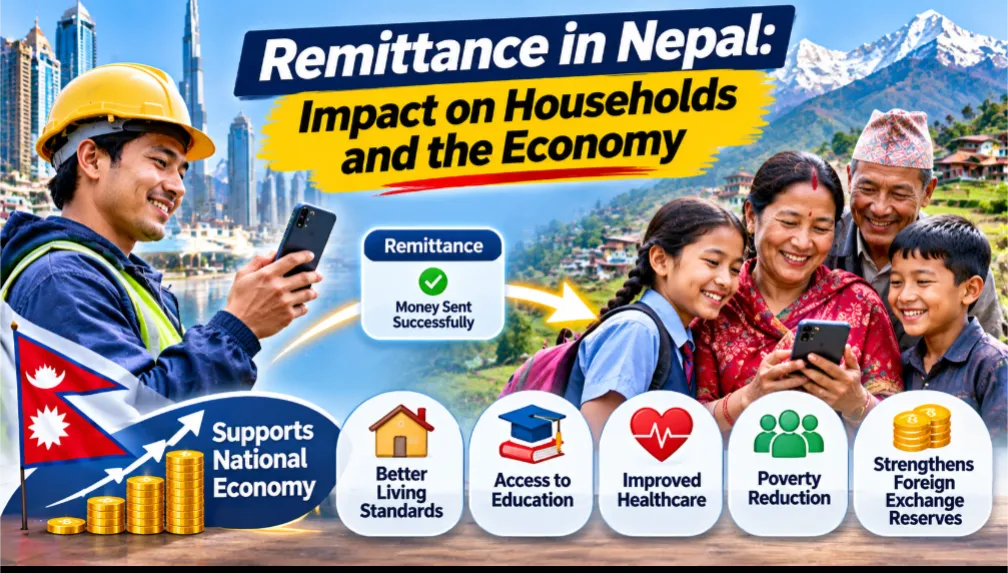
Remittance in Nepal: Impact on Households and the Economy
Remittance has become one of the most important sources of income for Nepal. Every year, millions of Nepalis working abroad send money to their families, helping them pay household expenses, educate their children, access healthcare, and improve their living conditions. For many families, money received from relatives working overseas is more than additional income; it is essential for financial security.
Remittance also plays a major role in Nepal's national economy. It supports foreign exchange reserves, strengthens the balance of payments, and helps finance imports. However, depending heavily on money earned abroad also creates challenges, including labor migration, domestic skill shortages, and limited investment in productive industries.
So, how does remittance affect ordinary households and Nepal's overall economy? Let's examine its benefits, challenges, and long-term importance.
How Much Remittance Does Nepal Receive?
Nepal receives billions of dollars in remittance every year, making it one of the country's most important sources of foreign income.
According to Nepal Rastra Bank's annual macroeconomic report for fiscal year 2025/26, Nepal received approximately NPR 2,363.13 billion in remittance during the year. This represented a 37.1% increase in Nepali rupee terms compared with the previous fiscal year. In US dollar terms, remittance increased by 28.1% to approximately USD 16.19 billion.
These figures demonstrate how important overseas employment has become for Nepal. A significant portion of the money earned by Nepali workers abroad eventually enters the domestic economy through banks and other formal transfer channels.
Countries in the Middle East, Malaysia, Japan, South Korea, and other international destinations provide employment opportunities for Nepali migrant workers. The amount sent home depends on workers' earnings, exchange rates, employment conditions, and the cost of living in their destination countries.
Impact of Remittance on Nepali Households
1. Better Living Standards
One of the most direct benefits of remittance is improved household living standards. Families receiving money from abroad can afford better housing, nutritious food, clothing, electricity, transportation, and other necessities.
For households with limited employment opportunities in rural areas, remittance can make a significant difference. It provides financial support that may not be available through local wages or agricultural income alone.
2. Better Access to Education
Education is another major area where remittance makes a difference. Parents working abroad often send money to pay school fees, purchase books, buy computers, and support their children's higher education.
Some families can afford private schools, technical training, and university education because of income earned by family members overseas. Over time, these educational opportunities can help younger generations develop skills and access better employment.
3. Improved Healthcare and Financial Security
Healthcare expenses can be difficult for low-income families, particularly when someone needs hospitalization or long-term treatment. Remittance provides additional money to cover medical bills, medicines, transportation, and health insurance where available.
It can also help families manage unexpected financial problems, such as crop losses, accidents, unemployment, and natural disasters. This financial support can reduce the need to borrow money during emergencies.
4. Poverty Reduction
Remittance has contributed to poverty reduction in Nepal by increasing household income and helping families meet basic needs. Research published by the Nepal Rastra Bank found that households receiving remittances were less likely to fall into poverty in its analysis of rural household data from 2018.
The World Bank has also identified migration and remittance as important contributors to Nepal's poverty reduction and economic resilience. However, the benefits are not distributed equally because not every household has a family member working abroad.
Impact of Remittance on Nepal's Economy
1. Supports Foreign Exchange Reserves
Nepal imports many essential goods, including petroleum products, machinery, vehicles, medicines, and industrial materials. To pay for these imports, the country needs foreign currency.
Remittance brings foreign currency into Nepal and helps support the country's external financial position. According to Nepal Rastra Bank, foreign exchange reserves reached approximately NPR 3,897.67 billion, equivalent to USD 25.31 billion, by mid-July 2026. The reserves were sufficient to cover 19.6 months of prospective merchandise and services imports.
Remittance is not the only factor behind foreign exchange reserves, but it is a major source of foreign currency for Nepal.
2. Supports Consumption and Domestic Businesses
When families receive money from abroad, they spend part of it on groceries, clothing, education, housing, transportation, healthcare, and other services.
This spending supports local businesses, shops, restaurants, transport operators, construction companies, and service providers. In this way, money earned overseas circulates through different parts of the domestic economy.
However, the economic benefit depends on where the money is spent. Spending on locally produced goods and services can support domestic employment, while spending on imported products increases demand for foreign currency.
3. Helps Strengthen the Balance of Payments
Nepal regularly imports more goods than it exports, creating a large trade deficit. Remittance helps offset some of the pressure created by this imbalance.
When foreign currency enters the country through formal remittance channels, it supports the current account and overall balance of payments. This makes remittance particularly important for a country that depends heavily on imports.
Challenges of Nepal's Dependence on Remittance
Despite its benefits, depending heavily on foreign employment and remittance can create long-term economic challenges.
1. Shortage of Workers in Nepal
When large numbers of working-age people leave the country, certain industries may struggle to find workers. Agriculture, construction, manufacturing, hospitality, and small businesses can face labor shortages.
This can increase operating costs and make it harder for domestic businesses to expand. It also raises questions about how Nepal can create attractive employment opportunities at home.
2. Limited Investment in Productive Industries
Much of the remittance received by households is used for daily expenses, education, housing, debt repayment, and other consumption needs. These uses are important for family welfare, but they do not always create businesses or productive assets.
The International Monetary Fund has highlighted concerns that remittance is often directed toward consumption and real estate-related activities rather than productive investment. Nepal needs better opportunities for households to invest in agriculture, manufacturing, tourism, technology, and small businesses.
3. Dependence on Foreign Labor Markets
Nepal's remittance income depends partly on employment conditions in other countries. Economic slowdowns, changes in immigration policies, political instability, regional conflicts, or reduced demand for migrant workers can affect the income of Nepali workers.
Families that depend on a single overseas income source can be particularly vulnerable if a worker loses employment or faces an emergency abroad.
Comparison: Positive and Negative Impacts of Remittance
| Area | Positive impact | Potential challenge |
|---|---|---|
| Household income | Improves purchasing power and living standards | Dependence on overseas earnings |
| Education | Helps pay school and university expenses | Unequal access between households |
| Healthcare | Provides money for treatment and emergencies | Income can be interrupted if workers lose jobs |
| Foreign exchange | Supports reserves and import payments | External dependence remains high |
| Local businesses | Increases consumer spending and demand | Some spending flows toward imported products |
| Employment | Creates overseas earning opportunities | Can contribute to domestic labor shortages |
| Investment | Can provide savings and startup capital | Not all remittance is invested productively |
How Can Nepal Use Remittance More Productively?
Nepal should not view remittance only as money used for household consumption. It can also become a source of long-term investment if the country develops the right financial and business opportunities.
- Encourage small businesses: Make it easier for returning migrant workers and their families to establish businesses.
- Improve financial literacy: Help households understand saving, budgeting, insurance, and responsible investment.
- Develop productive sectors: Create investment opportunities in agriculture, tourism, hydropower, manufacturing, and technology.
- Protect migrant workers: Improve access to reliable employment information, fair recruitment, insurance, and support services.
- Create domestic jobs: Strengthen industries so that young Nepalis have more opportunities to build careers at home.
Final Thoughts
Remittance is one of the strongest financial pillars of Nepal's economy. It supports millions of households, helps reduce poverty, finances education and healthcare, and provides foreign currency that the country needs for imports.
However, a country cannot depend indefinitely on sending its workforce abroad. Nepal needs to convert the financial benefits of remittance into stronger domestic industries, productive investment, and sustainable employment opportunities.
The long-term goal should not be to reduce the importance of migrant workers' contributions. It should be to build an economy where Nepalis can find good opportunities at home while continuing to benefit from the skills, savings, and experience of those working abroad.





Comments
Sign in to leave a comment.
Sign in