

Introduction
Information Technology (IT) has become an important career option for students and professionals in Nepal. Businesses increasingly depend on websites, software, digital payments, cloud services and online platforms. This creates opportunities for people with practical technology skills in Nepal and international markets.
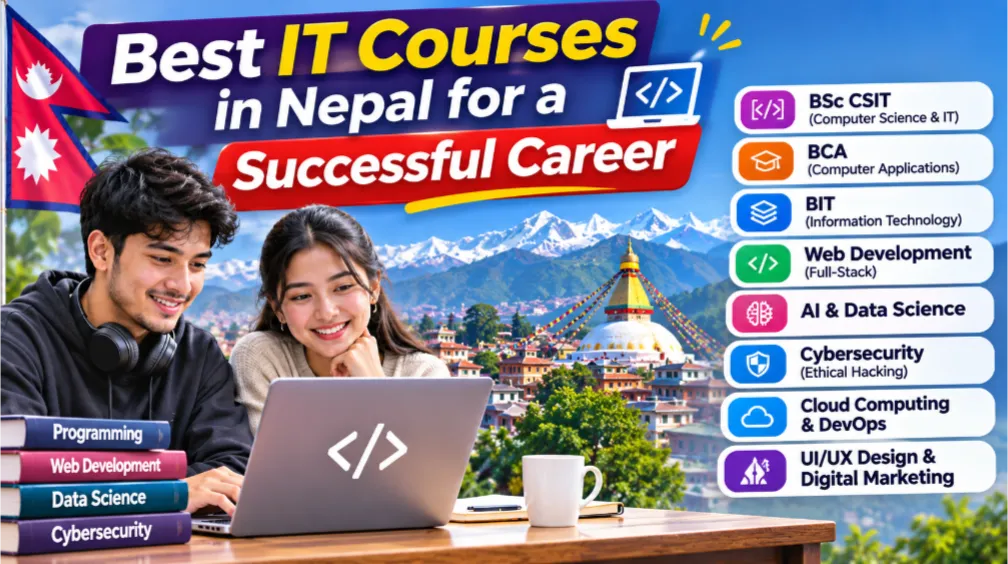
However, choosing the right IT course can be confusing. Students can pursue university degrees such as BSc CSIT, BCA and BIT or develop specialized skills through training in software development, cybersecurity, artificial intelligence, cloud computing and digital marketing.
The best IT course depends on your interests, educational background and career goals. Some courses provide a broad academic foundation, while others focus on specific technical skills. Here are some of the best IT courses to consider in Nepal.
Quick Comparison of the Best IT Courses in Nepal
Before exploring each course in detail, use this comparison to understand their main focus and possible career directions.
| IT Course | Main Focus and Career Opportunities |
|---|---|
| BSc CSIT | Computer science, programming and algorithms. Careers: software developer, system analyst and database professional. |
| BCA | Computer applications and software development. Careers: application developer, web developer and software tester. |
| BIT | Information systems, networking and IT infrastructure. Careers: IT officer, system administrator and network professional. |
| Web Development | Frontend, backend and full-stack programming. Careers: web developer, WordPress developer and freelance developer. |
| AI and Data Science | Python, data analysis and machine learning. Careers: data analyst, data scientist and machine learning engineer. |
| Cybersecurity | Network protection, security testing and incident response. Careers: security analyst and penetration tester. |
| Cloud Computing and DevOps | Cloud infrastructure, Linux and automation. Careers: cloud engineer, DevOps engineer and system administrator. |
| UI/UX and Digital Marketing | Interface design, SEO and online promotion. Careers: UI/UX designer, SEO specialist and digital marketing professional. |
Note: These are typical career pathways, not guaranteed job outcomes. Some advanced roles require additional experience, practical projects and professional qualifications.
1. BSc CSIT (Bachelor of Science in Computer Science and Information Technology)
BSc CSIT is a popular undergraduate option for students interested in computer science, programming and technology. It combines theoretical computer science with practical IT subjects.
Students generally study programming, data structures, algorithms, database management, computer networks, operating systems and software engineering. The programme can provide a foundation for further specialization in artificial intelligence, data science and cybersecurity.
Possible career opportunities:
- Software developer
- Web developer
- Database administrator
- System analyst
- IT professional
This degree may suit students who enjoy mathematics, logical thinking and understanding how computer systems work.
2. BCA (Bachelor of Computer Applications)
BCA focuses on computer applications, programming and software development. It is an option for students who want to understand how software applications are designed, developed and maintained.
Depending on the university curriculum, students may study programming languages, web technologies, databases, software engineering, networking and application development.
Possible career opportunities:
- Software developer
- Web developer
- Mobile application developer
- Software tester
- Application support specialist
BCA can be a suitable choice for students interested in building websites, business applications and mobile software. Check the admission requirements of the university before applying.
3. BIT (Bachelor of Information Technology)
BIT is a broad IT degree covering different areas of information technology. It can include programming, databases, networking, information systems, cybersecurity and system administration.
Unlike a narrowly focused training course, a university degree provides a wider academic foundation. Students can later specialize in software development, cloud infrastructure, network administration or other technical fields.
Possible career opportunities:
- IT officer
- Network administrator
- System administrator
- Software developer
- IT support specialist
BIT may suit students who want flexibility to explore different areas of technology before selecting a specialization.
4. Full-Stack Web Development
Full-stack web development is a practical training pathway for people who want to build websites and web applications. It covers both frontend development, which users interact with, and backend development, which handles application logic and data.
Important technologies include HTML, CSS, JavaScript, React, Node.js, PHP, Laravel and databases such as MySQL or PostgreSQL. Beginners should start with programming fundamentals and gradually build complete projects instead of trying to learn every technology simultaneously.
Possible career opportunities:
- Frontend developer
- Backend developer
- Full-stack developer
- WordPress developer
- Freelance web developer
This pathway is useful for learners who want to create websites, work with software companies or develop their own digital products.
5. Artificial Intelligence and Data Science
Artificial intelligence (AI) and data science are important areas of modern computing. AI involves developing systems that perform tasks such as recognizing patterns, understanding language and generating predictions. Data science focuses on collecting, processing and analysing information to support decisions.
Students should build a foundation in Python programming, mathematics, statistics, databases and data analysis. Advanced learning can include machine learning, deep learning, natural language processing and generative AI.
Possible career opportunities:
- Data analyst
- Data scientist
- Machine learning engineer
- AI application developer
- Business intelligence analyst
These fields offer interesting opportunities, but advanced AI and data science roles require strong technical foundations. A short introductory AI course alone is unlikely to qualify someone for an advanced engineering position.
6. Cybersecurity and Ethical Hacking
Cybersecurity focuses on protecting computer systems, networks, applications and information from unauthorized access and attacks. As organizations depend more heavily on digital systems, security knowledge is increasingly important.
Start with networking, Linux, operating systems and basic programming. You can then study security monitoring, vulnerability assessment, penetration testing, incident response and digital forensics.
Professional certifications such as CompTIA Security+ and Cisco security-related credentials may support further learning, depending on your career direction.
Possible career opportunities:
- Cybersecurity analyst
- Security operations centre (SOC) analyst
- Penetration tester
- Network security specialist
- Security administrator
Ethical hacking must only be practised on systems you own or have explicit permission to test.
7. Cloud Computing and DevOps
Cloud computing allows organizations to use computing resources such as servers, storage and databases through online infrastructure. DevOps combines development and operations practices to improve how software is built, tested and deployed.
Useful technologies include Linux, networking, AWS, Microsoft Azure, Google Cloud, Docker, Kubernetes, Git and CI/CD tools. Beginners should first understand operating systems, networking and basic server administration.
Possible career opportunities:
- Cloud engineer
- DevOps engineer
- Linux system administrator
- Cloud support engineer
- Infrastructure engineer
This pathway may suit learners interested in servers, hosting infrastructure, automation and managing production systems.
8. UI/UX Design and Digital Marketing
Not every IT career requires advanced programming. UI/UX design focuses on making websites and applications easy to use, visually appealing and accessible. Digital marketing uses online channels to help businesses reach customers and grow their presence.
For UI/UX design, learn Figma, wireframing, prototyping, user research and interface design. For digital marketing, focus on SEO, content marketing, social media, analytics and paid advertising.
Possible career opportunities:
- UI/UX designer
- Product designer
- SEO specialist
- Digital marketing executive
- Content strategist
- Social media manager
How to Choose the Right IT Course in Nepal
Before enrolling in an IT course, consider these important points:
- Identify your interests: Decide whether you enjoy programming, design, data, security, networking or business technology.
- Check eligibility: University degrees have specific academic requirements. Verify them before applying.
- Compare the curriculum: Review actual subjects, practical sessions and project requirements rather than relying only on the course title.
- Look for practical experience: Choose programmes that include projects, laboratories, internships or portfolio development.
- Check recognition: Verify the university affiliation, awarding institution and programme approval.
- Consider your budget: Compare tuition, examination, equipment and certification costs before making a decision.
Conclusion
Nepal offers several pathways for people who want to build careers in Information Technology. BSc CSIT, BCA and BIT provide broad academic foundations, while specialized training in web development, AI, cybersecurity, cloud computing and UI/UX design helps learners develop focused skills.
There is no single IT course that guarantees a successful career. Your results will depend on practical knowledge, consistent learning, real-world projects, communication skills and the ability to adapt to changing technologies.
Choose a course that matches your interests, build a portfolio and gain practical experience. With the right combination of education and skills, you can explore employment, freelancing, entrepreneurship and international opportunities in the technology sector.
Useful Resources and Further Reading
- Tribhuvan University – University and academic programme information.
- Institute of Engineering, Tribhuvan University – Engineering education and admission information.
- Kathmandu University – Academic programmes and admissions.
- Coursera – Online technology courses and professional certificates.
- freeCodeCamp – Free programming and web development learning resources.
- IBM SkillsBuild – Digital skills and technology learning resources.
Disclaimer: Course availability, eligibility, fees, curriculum and university affiliations can change. Confirm the latest details directly with the relevant university or institution before enrolling. Career opportunities are not guaranteed by completing a course.




Comments
Sign in to leave a comment.
Sign in