

<h1>BSc CSIT vs BIT in Nepal: Which Course Is Better?</h1>
<p>Choosing the right IT degree after completing +2 is an important decision for students in Nepal. Two popular options are Bachelor of Science in Computer Science and Information Technology (BSc CSIT) and Bachelor of Information Technology (BIT). Both programmes can lead to careers in software development, networking, cybersecurity, database management, and other technology fields.</p>
<p>However, BSc CSIT and BIT are not exactly the same. They have different academic approaches, subject combinations, and admission requirements. Understanding these differences can help you choose a course that matches your interests, educational background, and career plans.</p>
<h2>What Is BSc CSIT in Nepal?</h2>
<p>BSc CSIT is a four-year undergraduate programme offered by Tribhuvan University (TU) through its Institute of Science and Technology (IOST). It combines computer science fundamentals with practical information technology subjects.</p>
<p>The curriculum covers programming, mathematics, data structures, algorithms, computer architecture, operating systems, database management, software engineering, computer networks, and other computing topics.</p>
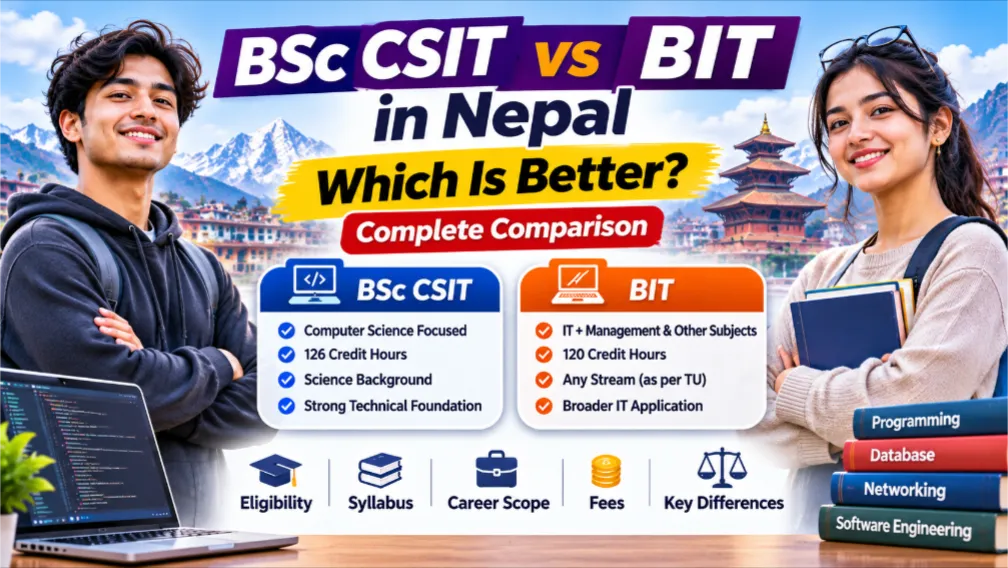
<p>According to TU's published curriculum, students complete 126 credit hours. The programme is designed to develop knowledge of computer theory, software design, programming, and hardware systems.</p>
<p>BSc CSIT is particularly relevant to students interested in understanding how computer systems work and developing strong technical foundations.</p>
<h2>What Is BIT in Nepal?</h2>
<p>Bachelor of Information Technology (BIT) is also a four-year undergraduate programme offered by Tribhuvan University. Its curriculum focuses on information technology and its practical application across different industries.</p>
<p>According to TU's BIT curriculum, students complete 120 credit hours. Alongside core IT subjects, the programme includes mathematics, statistics, management, economics, sociology, psychology, research methodology, and technical writing.</p>
<p>BIT covers areas such as software development, information security, database administration, networking, and system administration. Its broader subject combination can be useful for students interested in technology roles that involve organizational and business requirements.</p>
<h2>BSc CSIT vs BIT: Quick Comparison</h2>
<table>
<thead>
<tr>
<th>Comparison</th>
<th>BSc CSIT</th>
<th>BIT</th>
</tr>
</thead>
<tbody>
<tr>
<td>Full form</td>
<td>Bachelor of Science in Computer Science and Information Technology</td>
<td>Bachelor of Information Technology</td>
</tr>
<tr>
<td>Duration</td>
<td>4 years</td>
<td>4 years</td>
</tr>
<tr>
<td>Semesters</td>
<td>8</td>
<td>8</td>
</tr>
<tr>
<td>Credit hours</td>
<td>126</td>
<td>120</td>
</tr>
<tr>
<td>Academic focus</td>
<td>Computer science and IT</td>
<td>Information technology and its applications</td>
</tr>
<tr>
<td>Mathematics</td>
<td>Strong computer science and mathematical foundation</td>
<td>Mathematics and statistics within a broader IT curriculum</td>
</tr>
<tr>
<td>Additional subjects</td>
<td>Science and computing-related subjects</td>
<td>Management, economics, sociology, psychology, and communication-related subjects</td>
</tr>
<tr>
<td>Eligibility at TU</td>
<td>Science background with specified subject requirements</td>
<td>Any stream under the published curriculum, subject to admission requirements</td>
</tr>
<tr>
<td>Career areas</td>
<td>Software development, systems, databases, networking, and computing</td>
<td>Software development, IT services, networking, security, and system administration</td>
</tr>
</tbody>
</table>
<p><em>Note: This comparison refers to Tribhuvan University's programmes. Other universities may have different BIT curricula, credit requirements, and admission rules.</em></p>
<h2>Eligibility and Admission Requirements</h2>
<p>One of the most important differences is the educational background required for admission.</p>
<h3>BSc CSIT Eligibility</h3>
<p>For TU's BSc CSIT programme, students generally need to complete +2 Science or an equivalent qualification recognized by TU. The published curriculum specifies Physics and Mathematics requirements, along with minimum academic grades. Applicants must also meet the entrance examination and admission requirements announced for their admission year.</p>
<h3>BIT Eligibility</h3>
<p>TU's published BIT curriculum allows students who have completed twelve years of schooling in any stream or an equivalent qualification to apply. The curriculum also specifies academic and entrance examination requirements.</p>
<p>This makes BIT an option worth investigating for students from Management, Humanities, and other backgrounds. However, always check the latest official admission notice because eligibility conditions can be updated.</p>
<h2>Which Course Offers Better Career Opportunities?</h2>
<p>Both degrees can provide a foundation for working in Nepal's growing technology sector. The actual career opportunities depend on your technical skills, projects, internships, communication abilities, and practical experience.</p>
<p>After BSc CSIT, graduates may pursue roles such as:</p>
<ul>
<li>Software developer</li>
<li>Backend or frontend developer</li>
<li>Database administrator</li>
<li>System or network engineer</li>
<li>Cybersecurity professional</li>
<li>Data or computing-related specialist</li>
</ul>
<p>BIT graduates may also pursue many of these roles, including:</p>
<ul>
<li>Software developer</li>
<li>IT support specialist</li>
<li>Network administrator</li>
<li>Database administrator</li>
<li>Information security professional</li>
<li>System administrator</li>
</ul>
<p>There is considerable overlap between the career paths. A BIT graduate with strong programming skills can become a software developer, just as a BSc CSIT graduate can work in IT management or support. Employers generally evaluate practical ability and relevant experience rather than relying only on the degree title.</p>
<h2>Which Course Should You Choose?</h2>
<p>Consider BSc CSIT if you are from a qualifying science background, enjoy mathematics and logical problem-solving, and want to study computer science fundamentals in greater depth.</p>
<p>Consider BIT if you want a broader information technology education, are interested in how technology is used in organizations, or come from a non-science background and meet the programme's admission requirements.</p>
<p>Before selecting a college, compare its affiliation, updated syllabus, teaching quality, laboratory facilities, faculty, internship opportunities, project work, total fees, and graduate outcomes. The quality of the institution and the effort you put into developing practical skills can significantly influence your education.</p>
<h2>Final Verdict: BSc CSIT vs BIT in Nepal</h2>
<p>There is no single answer to which course is better for every student. BSc CSIT provides a more computer-science-focused academic foundation, while BIT offers a broader IT curriculum that includes management and other supporting subjects.</p>
<p>If you enjoy programming, mathematics, algorithms, and deeper computing concepts, BSc CSIT may suit your interests. If you prefer a wider IT education and want to understand how technology supports businesses and organizations, BIT may be a suitable choice.</p>
<p>Remember that neither degree automatically guarantees a job or a high salary. Build real projects, learn in-demand technologies, complete internships, and develop problem-solving skills alongside your studies. These practical abilities can make a meaningful difference in your IT career.</p>
<h2>Reliable Sources and Further Reading</h2>
<ul>
<li><a href="https://portal.tu.edu.np/downloads/2025_02_27_13_51_20.pdf" target="_blank" rel="noopener">Tribhuvan University – BSc CSIT Curriculum and Eligibility</a></li>
<li><a href="https://portal.tu.edu.np/downloads/BIT_First-to-Sixth-Semester-Sy_2024_06_25_11_58_19.pdf" target="_blank" rel="noopener">Tribhuvan University – BIT Curriculum and Eligibility</a></li>
<li><a href="https://cdcsit.edu.np/courses/bit-academics/" target="_blank" rel="noopener">TU Central Department of Computer Science and Information Technology – BIT Academics</a></li>
<li><a href="https://www.cdcsit.tu.edu.np/pages/bs-2733" target="_blank" rel="noopener">TU Central Department – BSc CSIT Programme</a></li>
</ul>







Comments
Sign in to leave a comment.
Sign in